ABC Flashcards

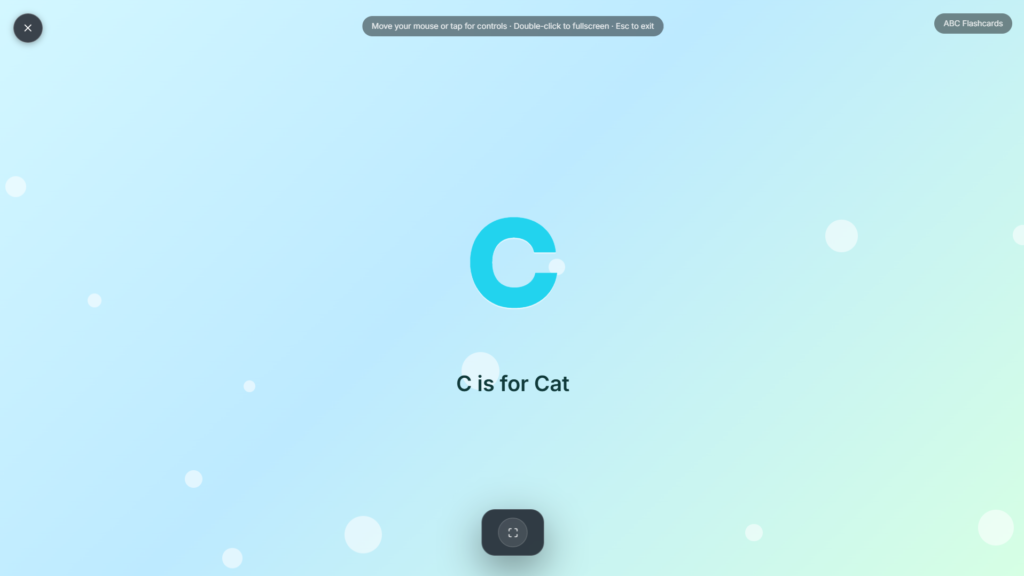
A letter appears, large and colorful, paired with a picture and its sound, one card at a time through the alphabet. No app store, no download, just abc flashcards for toddlers that run directly in the browser.
Why Letter and Sound Pairing Works So Well
Pairing a letter with a picture and its sound draws on something researchers call the alphabetic principle, the understanding that letters represent specific sounds, which is the foundation everything else in reading eventually builds on. Seeing a letter, hearing its sound, and connecting it to a familiar picture all at once, an apple for A, a ball for B, gives a toddler three different ways into the same piece of information, which tends to help it stick better than any single method alone.
What Toddlers Actually Get Out of Flashcards
At the toddler stage, the goal usually isn’t reading yet, it’s letter recognition and the early sense that squiggles on a page carry meaning. Repetition matters more here than variety, seeing the same letter presented consistently, in the same style, tends to help a young child commit its shape to memory before moving on to recognizing it in different fonts or contexts. Letter sounds specifically, not just names, are worth emphasizing early too, since phonics instruction, sounding out words based on the letters that make them up, depends far more on knowing what a letter sounds like than what it’s called. Children generally learn letter names before letter sounds in casual exposure, which is part of why flashcards that emphasize the sound out loud each time are worth the extra effort.
How to Use This Well with a Toddler
- Say the letter and its sound out loud together, not just the name, “A says ah” reinforces more than “A” alone.
- Don’t rush through the whole alphabet in one sitting, a handful of letters revisited often works better than 26 seen once.
- Point to the picture and name it too, connecting “A” to “apple” out loud strengthens the link between the letter and something familiar.
- Repeat the same few letters across several days before introducing new ones, letter recognition builds through repetition more than exposure to variety.
Who This ABC flashcards for toddlers Built For
This suits toddlers and early preschoolers just starting to learn letters, roughly 18 months through age 4, along with parents and caregivers looking for a simple, screen based way to reinforce what’s being taught at daycare or in early preschool. Once a flashcard session wraps up, Good Night Stars works well as a calming transition if it’s close to bedtime, and Counting Fun or 2D Shapes cover the numbers and shapes side of early learning.
FAQ
What age is this best suited for?
Roughly 18 months through age 4, though it depends heavily on where an individual child is with early language.
Should I focus on letter names or letter sounds first?
Letter sounds tend to matter more for later reading than letter names, so it’s worth emphasizing sounds even if names come first naturally.
Do I need to create an account?
No, it runs directly in the browser, no signup or personal information required.
Is this a replacement for reading books together?
No, it’s a supplementary activity. Reading aloud together remains one of the most valuable things you can do for early literacy, this just adds another angle.
Can this be used on a tablet?
Yes, it works in any modern mobile browser as well as on a laptop or desktop.
Is any of my child’s activity or data collected?
No, it runs locally in the browser with nothing uploaded or stored.


