Counting Fun

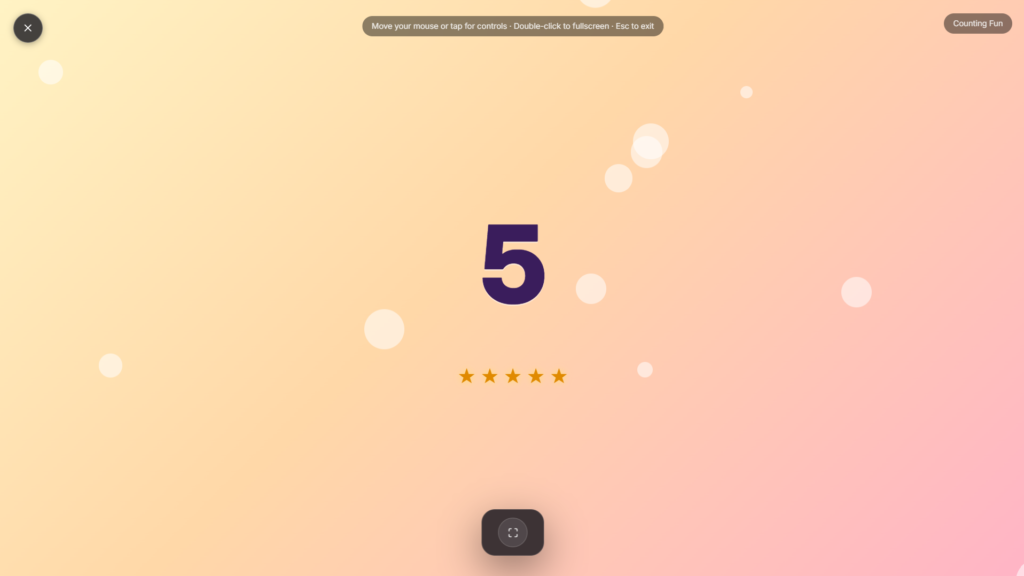
A big number appears on screen, alongside that same number of stars underneath it, 2 with two stars, 5 with five stars, and so on through 1 to 10. No quiz, no wrong answers, just fun counting activities that let a child see a number and its matching quantity side by side.
Why Fun Counting Activities Matter Early On
Counting is usually a child’s very first real math skill, well before addition or shapes come into the picture. Early number sense, the intuitive feel for quantity and order that counting builds, has been linked by researchers to stronger math performance well into later school years.
Practicing through play rather than a worksheet tends to hold a young child’s attention longer too, which matters since repetition is really what builds the skill, not any single clever exercise. Counting also tends to work best woven into things a child already finds engaging, colors, characters, small rewards for a correct answer, rather than presented as a dry drill.
What This Kind of Activity Actually Builds
Counting the stars underneath the number, one at a time out loud, helps a child connect a number word and its written symbol to an actual quantity, a skill researchers call one-to-one correspondence. Recognizing a small group of stars at a glance, without counting each one individually, is a related but separate skill called subitizing, and both tend to get exercised naturally by seeing a number and its matching count side by side, over and over across 1 through 10. That repetition is what builds toward the more abstract idea that numbers represent quantities consistently, regardless of what’s actually being counted.
How to Use It Well with a Child
- Count the stars out loud together each time the number changes, hearing the number said alongside the count reinforces the connection.
- Point at each star as you count it, touching or pointing to each one helps a child track which they’ve already counted.
- Move through numbers slowly, lingering on a number for a moment rather than clicking through 1 to 10 quickly.
- Mix in real-world counting too, stairs, toys, snacks, the skill transfers better when it isn’t only practiced on a screen.
Who This Is Built For
This suits preschool and early kindergarten age children just starting to learn numbers, as well as parents and teachers looking for a quick, screen based counting activity to use during a lesson or a quiet moment at home. It’s simple enough not to need reading skills, which matters for an age group that’s often still learning letters alongside numbers. Once a counting session wraps up, something calmer like Campfire or Natural Scenery can make for a gentle wind-down visual before moving on to the next part of the day.
FAQ
What age is this best suited for?
Roughly preschool through early kindergarten age, typically 3 to 6 years old, though the right fit depends on where an individual child is with numbers.
Do I need to create an account for my child?
No, it runs directly as a page in the browser, no signup or personal information needed.
Is this a full replacement for classroom math instruction?
No, it’s a supplementary activity rather than a full curriculum, useful alongside classroom teaching or as extra practice at home.
Can this be used on a tablet or phone?
Yes, it works in any modern mobile browser as well as on a laptop or desktop.
Is any of my child’s activity or data collected?
No, it runs locally in the browser with nothing uploaded or stored.
Does it go beyond the number 10?
The core activity covers 1 through 10, the range most early counting practice focuses on before moving to bigger numbers.


