AI Accuracy Warning

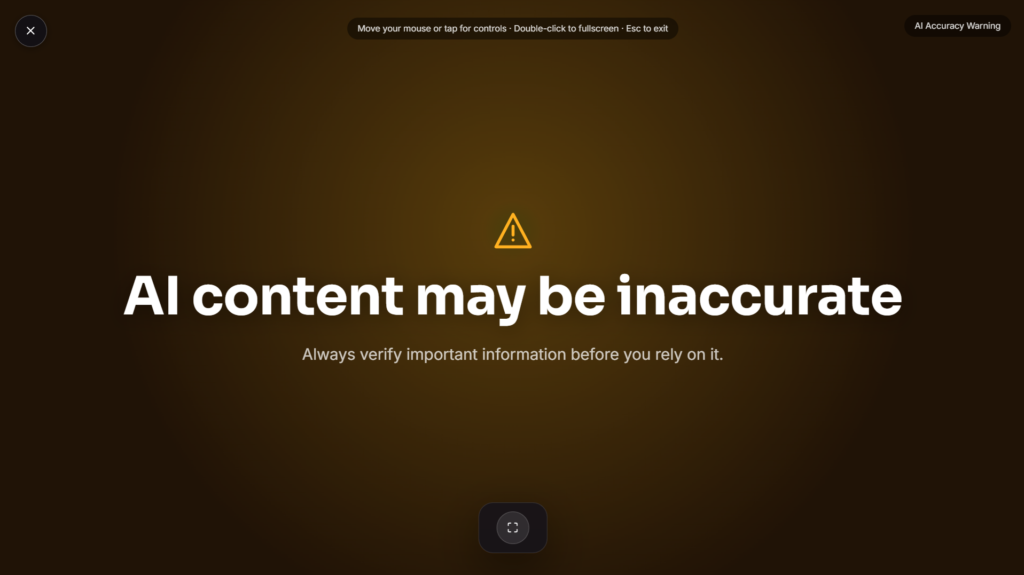
A warning message fills the screen with the same style disclaimer real AI tools display constantly, a caution icon, a bold headline, and a short reminder to verify anything important before relying on it.
Why This Warning Message Sounds So Familiar
This exact style of disclaimer shows up across nearly every major AI chatbot in some form, ChatGPT, Gemini, and Copilot all display some version of a caution about the possibility of mistakes beneath their responses. That’s not just legal caution for its own sake, it reflects a real, well-documented limitation called hallucination, where a language model generates text that sounds confident and coherent but is factually wrong. Because a model can’t tell the difference between something it’s confident about and something it’s actually correct about, a standing reminder to verify important information has become a near-universal convention across AI products rather than something any single company added arbitrarily. The problem is genuinely difficult to solve entirely, even the most advanced models still occasionally generate plausible-sounding but incorrect details, which is exactly why the disclaimer hasn’t disappeared as models have improved.
What Makes a Warning Message Like This Effective
A short, direct warning tends to land better than a long disclaimer nobody reads. Pairing a caution icon with a bold, simple headline and a single supporting sentence follows the same pattern used across countless real dialog boxes and interface warnings, enough to register at a glance without demanding the kind of attention a full paragraph of legal text would need. Keeping the message general, “verify important information,” rather than listing every possible failure mode, also keeps it usable across a wide range of contexts rather than needing constant rewriting.
Common Ways People Use This Warning Message
This works well as a genuine disclaimer for a demo or presentation showing AI-generated content, a visual prop for content explaining how AI tools work, or a placeholder for a real product interface still in development. If you’re building out a broader set of AI-themed visuals, AI Content Scan and Typing Text Effect cover different sides of the same general AI aesthetic.
FAQ
Is this a real warning generated by an actual AI system?
No, it’s a static display rather than something connected to a live AI model or triggered by real output.
Can I use this as an actual disclaimer for my own AI product?
It works well as visual inspiration or a placeholder during development, though a production product would typically want its own wording reviewed for its specific use case rather than generic text.
Why do AI tools need this kind of disclaimer at all?
Because language models can generate confident-sounding but incorrect information, a known limitation researchers call hallucination, a standing reminder to verify important output has become standard practice across the industry.
Do I need to download anything?
No, it plays directly in your browser, nothing to install.
Can I customize the wording of the message?
Depending on the build, many versions let you edit the text rather than being locked to a single fixed message.
Is any of my data collected while I use it?
No, it runs locally in your browser with nothing uploaded.
Why don’t AI companies just fix hallucination instead of adding a warning?
It’s an active, ongoing area of research rather than a solved problem, model improvements have reduced how often it happens, but eliminating it entirely has proven much harder than reducing its frequency, which is why the disclaimer remains standard practice rather than a temporary stopgap.
Does this apply to AI-generated images and audio too, or just text?
The specific hallucination problem this message references is mostly discussed in the context of text and factual claims, though AI-generated images and audio carry their own separate set of accuracy and authenticity concerns worth a different kind of disclaimer.
Should every AI product include a warning message like this?
Most major consumer AI products now do in some form, and it’s generally considered good practice for any tool where users might reasonably rely on AI-generated output as factual without double-checking it themselves.
More AI & Machine Learning

Deploying Model
Terminal-style ML deploy log
Voice Assistant
Siri-style listening waveform orb
Model Training
Animated epoch progress for a training stream
AI Content Scan
Scanning line detecting AI-generated content
Neural Network
Animated node & synapse graph, drifting and pulsing