Radar Screen

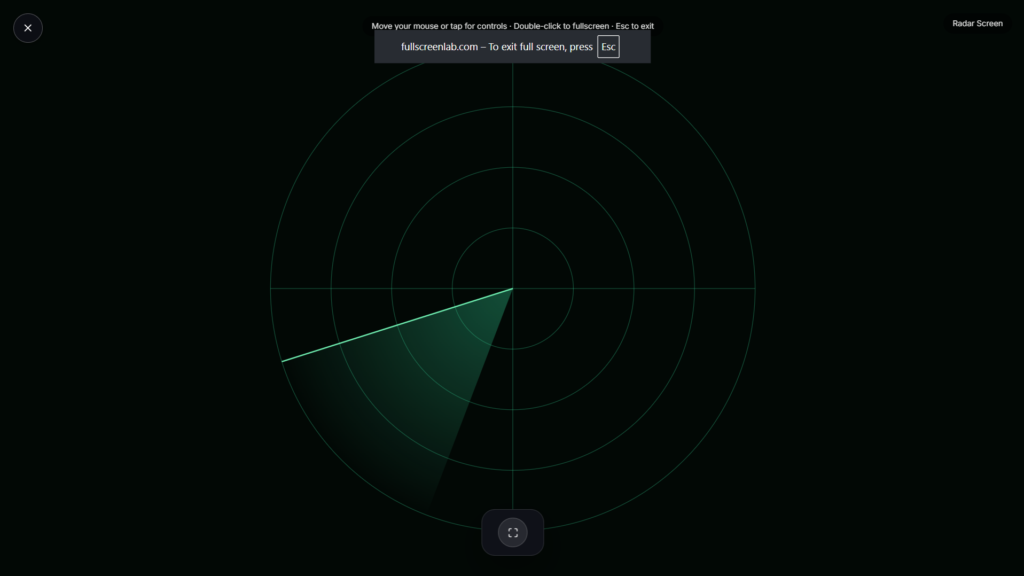
A radar screen sweeps steadily across a dark display, a glowing line rotating around a center point, tracking blips the way a real air traffic control tower or submarine console would. No hardware, no clearance required, just the command-center look running fullscreen in your browser.
The Real Technology Behind a Radar Screen
Actual radar works by sending out radio waves and measuring how long it takes for the reflection to bounce back off an object, which is how the technology gets its name, an acronym for RAdio Detection And Ranging. A rotating antenna sweeps a beam around in a circle, and anything it detects shows up as a blip at the matching angle and distance on the display, which is exactly the sweep-and-blip pattern this screen recreates visually.
Why the Glow Trails Behind the Sweep Line
The glowing trail that lingers behind the sweep line on a classic radar screen comes from phosphor persistence, a property of the coating used inside old cathode-ray tube displays that keeps glowing for a moment after being struck by the display’s electron beam, rather than switching off instantly. Real radar operators relied on that lingering glow to track a target’s recent position even between sweeps, since a single instantaneous sweep alone wouldn’t leave enough visual information to judge which direction a target was moving. This screen recreates that same fading trail digitally, which is part of what makes it read as an authentic radar display rather than just a rotating line.
Common Ways People Use a Radar Screen
A radar screen works well as a tech-themed desktop background, a prop for a military or sci-fi themed video, a stream backdrop with a surveillance or command-center feel, or just a fun visual for a movie night setup. It also shows up fairly often in cosplay and film prop work, a convincing radar display propped in the background of a scene is far easier to fake with a browser tab than to build as an actual physical prop. If a different kind of retro-tech aesthetic appeals more, Matrix Rain or Neon Grid cover that ground instead. For a blockier, more game-inspired retro look, Pixel Background is worth a look too.
FAQ
Is this tracking anything real?
No, the blips are generated for visual effect, not connected to any actual detection system or real-world data.
Do I need to download anything?
No, it runs directly in your browser, nothing to install.
Can I adjust the sweep speed?
Depending on the build, many radar screen tools let you adjust sweep speed, blip density, and how long the glow trail lingers.
Does this include sound effects?
Some versions include radar pings or ambient console sound as an optional layer, treat it as something you switch on rather than something playing by default.
Will this work on my phone?
Yes, it renders the same in any modern mobile browser as it does on a laptop or desktop.
Is any of my data collected while I use it?
No, it runs locally in your browser with nothing uploaded.
Is this based on a specific type of real radar system, like air traffic control or naval sonar?
It’s a general recreation of the classic sweep-and-blip look shared across many radar and sonar displays rather than a simulation of one specific real system, air traffic control, weather radar, and naval sonar all use a broadly similar circular sweep display.
More Prank Screens

Signal Glitch
RGB-split video tearing, like a dying signal
Shattered Display
Broken LCD color bars with a radiating glass-shatter crack
Acid Damage Screen
Toxic yellow-green broken LCD with a torn peeling corner
Hacker Typer
Fake code, type on your keyboard
Liquid Damage
Broken LCD with RGB sub-pixel bars and a torn peeling corner