Pomodoro Timer

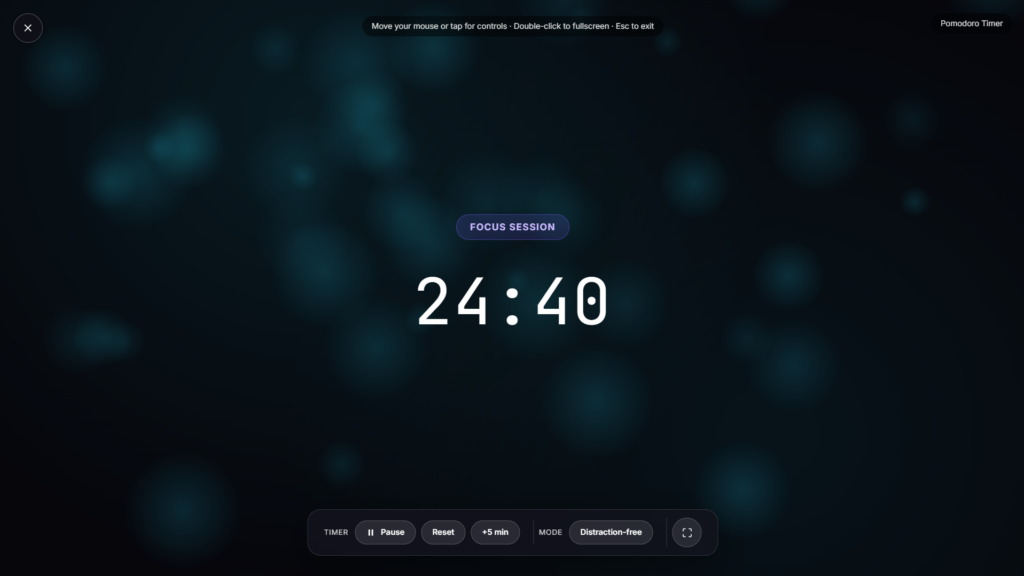
25 minutes of focused work, then a short break, repeated in a structured cycle designed to keep your attention on one task at a time. Run it fullscreen so the countdown stays visible without a browser tab competing for your attention.
Where the Pomodoro Timer Method Comes From
The technique traces back to a specific, small moment: Francesco Cirillo, a university student in the late 1980s struggling to focus on his studies, grabbed the nearest timer in his kitchen, a tomato-shaped one, and bet himself he could concentrate for just ten minutes straight. That worked, and Cirillo kept refining the idea over the following years into the structure most people use today: a set work interval, a short break, and a longer break every fourth cycle. The name stuck too, pomodoro is simply Italian for tomato.
How the Cycle Works
Pick one task, start the timer, and work on nothing else until it rings. A short break follows, typically a few minutes, before the next interval starts. After four intervals, a longer break gives you a real pause rather than another quick breather. The structure is closely related to timeboxing, the broader idea of assigning a fixed, non-negotiable time slot to a task rather than letting it expand to fill however long you happen to spend on it.
Why the Structure Works for Some People and Not Others
A visible, ticking countdown gives a task a hard edge it wouldn’t otherwise have, useful if you tend to lose track of time or let a task drag past when it’s actually done. It’s less useful for work that genuinely needs long, uninterrupted stretches, deep writing or complex debugging can suffer from being cut off right as you hit a rhythm. Worth treating the 25-minute default as a starting point rather than a fixed rule, plenty of people who use this method settle on their own interval length once they’ve got a feel for how their own focus holds up.
Pairing It with the Rest of Your Setup
If 25 minutes doesn’t suit your task and you want full control over the length instead, an Adjustable Timer lets you set any duration rather than sticking to the standard cycle. If you just need to see the current time rather than count down a work block, a Flip Clock covers that. And for something calming to glance at during your break, Ambient Light or Candle Flame work well as a brief visual reset before the next interval starts.
FAQ
Does it have to be exactly 25 minutes?
No, that’s just the original default. Plenty of people adjust the length once they’ve got a sense of their own focus span.
What happens after four work intervals?
A longer break follows, typically 15 to 30 minutes, before the cycle starts again from the first interval.
Do I need to download anything?
No, it runs as a page in your browser, nothing to install.
Can I use this for studying instead of work?
Yes, the method was originally built by a student for exactly that, it applies just as well to studying as it does to office work.
More Productivity & Timers

Adjustable Timer
Fully adjustable count-down with +/-1 and +/-5 min controls
Stopwatch
Count-up stopwatch with lap tracking
Custom Countdown
Adjustable countdown for any event
Women Power
Quotes celebrating women's strength & ambition
Daily Motivation
Rotating motivational quotes